
California requires an evacuation chair at every stairwell
Health and Safety Code §1569.695 has required every residential care facility for the elderly to keep an evacuation chair at each stairwell since July 1, 2019. It is a flat requirement, not a plan, and it is separate from the emergency-plan language in the same section.
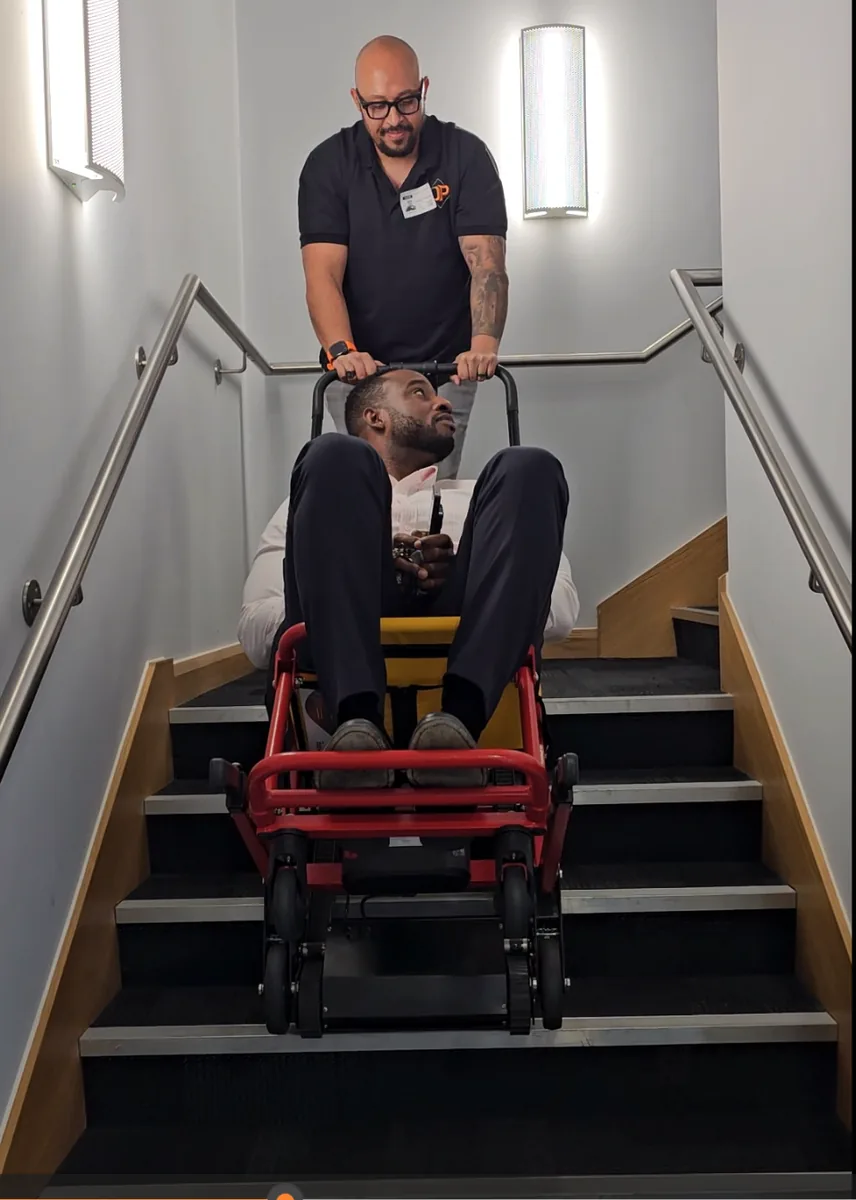
Yes — if your RCFE has stairwells, California law requires an evacuation chair at each one, and has since July 1, 2019. That obligation sits in Health and Safety Code §1569.695(f)(1), alongside a set of items a licensing analyst can ask to see on any visit. It is separate from the backup-power bill that failed this session, and separate again from the generator rule that covers skilled nursing facilities but not assisted living.
What the statute actually says
Health and Safety Code §1569.695(f) is one sentence long and leaves no room to interpret. A facility shall have “an evacuation chair at each stairwell, on or before July 1, 2019.”
There is no exemption by facility size, no phase-in left to wait for, and no language making it conditional on a risk assessment. The deadline passed seven years ago. If your building has three stairwells, the statute contemplates three chairs.
The only facilities it does not reach are the ones with no stairwell at all. A single-storey community has nothing to place.
Is this a national requirement? No
California appears to be alone in naming the equipment. We read the assisted living and nursing home rules in fourteen states, spot-checked six more, and read the federal rules. No other state rule we read names an evacuation chair, and no federal rule does — not the CMS emergency preparedness rule, not OSHA, not the ADA standards, which cover fixed and built-in elements and so do not reach a chair at all.
What the rest of the country requires is the outcome, with the method left to the operator. Illinois asks for “sufficient staff … present and awake to enable these residents to move to a safe area 24 hours per day.” Florida asks for identification of residents “with mobility limitations who may need specialized assistance.” The International Fire Code, adopted in most states, asks for “procedures for assisted rescue for persons unable to use the general means of egress unassisted.” Real obligations, silent on equipment.
Several states answer the stairs a different way entirely. Washington and Ohio require residents who cannot manage stairs to live on a floor that exits to ground level. Pennsylvania requires a fire-safe area on the same floor as each resident with mobility needs. Those are construction and placement answers rather than equipment answers, and they are just as lawful.
One more thing worth knowing if you are relying on the building code: an area of refuge — the code's own provision for people who cannot use stairs — is not required in a building that is fully sprinklered, which covers most new construction.
Georgia is worth borrowing an idea from. Its fire code sets a thirteen-minute standard for getting everyone to a point of safety, and offers two ways to meet it: sprinkler the building, or add staff. A chair is a third way to hit the same clock, which is the honest argument for one everywhere outside California.
Two limits on what we just told you, because they matter. Several national standards that states adopt by reference — NFPA 101 and NFPA 1 among them — sit behind paywalls, and we have not read them, so we make no claim about what they require. And we did not survey city and county ordinances, which is the most likely place a local requirement is hiding. If you know of one, we would genuinely like to hear about it.
Backup power is a plan, not a generator
This is the clause worth reading twice. §1569.695(a)(7)(A) asks for “provision of emergency power that could include identification of suppliers of backup generators.” Identification of a supplier satisfies it. If a permanent generator is used, the plan must say where it is and how it will be used; if a portable one is used, the manufacturer's instructions govern.
That is a documentation requirement. A bill that would have converted it into an actual capability — 72 hours of backup power, held to a real standard — did not pass this session. Until one does, the standard your plan is measured against is the one above.
What “at each stairwell” means once you own the chairs
A chair satisfies the statute by being present. It protects a resident only if somebody can use it, which the same section addresses from a different direction: training at hire and annually, and a drill every quarter on every shift.
Two failures the statute itself anticipates. The first is a chair stored in a locked room — which also runs into subsection (f)(2), the requirement that keys on each shift open the cabinets holding plan supplies. The second is a chair nobody on the night shift has touched, in a building where the night shift is the thinnest.
If you buy nothing else this year, put the chairs where the stairs are and run one drill per shift on them. That is the statute's own logic: equipment, then the training that makes it work.
What to check this week
Walk the building and count the stairwells, then count the chairs. If those two numbers differ, that is the finding. Closing it takes more than a purchase order: the chair has to be staged at the stairwell, staff have to be trained to use it, and the drill has to be documented with the date, the emergency covered, and the names of the staff who took part.
Then open the plan and check the four items the statute names separately from the chair: the assembly point drawn on the sketch, the second shelter outside the immediate area, the drill log with names on it, and the annual review page with a signature and a date.
- ›California has required an evacuation chair at each stairwell in every RCFE since July 1, 2019 — HSC §1569.695(f)(1).
- ›SB 435, the 72-hour backup-power bill, is not law. It was held in Assembly Appropriations on August 13, 2026.
- ›AB 2511's generator requirement applies to skilled nursing facilities, not to RCFEs.
- ›The statute's power clause is satisfied by identifying a generator supplier in the plan. Owning a generator is not required.
- ›Training at hire and annually, and a documented drill each quarter on each shift, are part of the same section as the chair.
Questions professionals ask
If the building has a stairwell, yes — one at each stairwell, required since July 1, 2019 under Health and Safety Code §1569.695(f)(1). A single-storey facility with no stairwell has nothing to place.
No. It passed the Senate 39–0 in June 2025 and was held in the Assembly Appropriations Committee on August 13, 2026. It did not pass in the 2025–26 session. Bills held on suspense can return under a new number in a later session.
Not under §1569.695. The statute asks for emergency power procedures, which it says may consist of identifying suppliers of backup generators. If you do install one, the plan must record its location and how it will be used. The generator mandate you may have heard about, AB 2511, applies to skilled nursing facilities.
Not that we could find. We read the assisted living and nursing home rules in fourteen states, spot-checked six more, and read the federal rules; California is the only one that names the equipment. We did not read the paywalled national standards that states adopt by reference, and we did not survey local ordinances. Elsewhere the law requires procedures for evacuating people who cannot use stairs and leaves the method to you. That is a real obligation — it simply is not a purchase order.
The statute sets the floor at one per stairwell. Buildings where several floors house residents who cannot self-evacuate often place one per floor per stairwell, so that a chair is on the level where it is needed rather than below it. That is an operational judgement, not a legal one.
- Health and Safety Code §1569.695 (California Legislative Information)
- SB 435 — bill history (California Legislative Information)
- SB 582 (2025) — most recent amendment to §1569.695, Chapter 546, Statutes of 2025
- AB 3098 (2018) — amended §1569.695, Chapter 348, Statutes of 2018
- AB 2511 (2022) — skilled nursing backup power, Chapter 788, Statutes of 2022
We write these guides so you can act on them without buying anything. Everything here is drawn from public federal preparedness guidance and from packing these kits ourselves. Last updated September 15, 2026.
The RCFE Readiness Score walks the same list and tells you which items you could evidence today.