
Could you get every resident down the stairs tonight?
For most RCFEs the honest answer is no. The Evac & Power Readiness System closes that gap under one vendor — evacuation, power, supplies, training, drills, and the documentation a surveyor asks for.
California already requires an evacuation chair at each stairwell in every licensed RCFE — Health & Safety Code §1569.695(f)(1), in force since July 1, 2019. What the statute says →
An evacuation chair at each stairwell.
Health & Safety Code §1569.695(f)(1) requires an evacuation chair at each stairwell for covered RCFEs, and has since July 1, 2019. The same section carries three more duties that licensing analysts ask about on a visit:
- an emergency plan that keeps the facility self-reliant for 72 hours, including a power failure
- staff training on that plan at hire and annually
- a drill at least quarterly, on every shift — documented
When a chair is missing, the citation comes with a plan of correction and a date: buy the chairs, then send proof of purchase. Facilities are cited for missed drills and missing documentation the same way.
It is not a rule that goes unenforced. In the 12 months to September 2026, §1569.695 was the 7th most-cited section across California's licensed RCFEs — 472 citations, 117 of them in the last 90 days.
See the full ranking from CDSS licensing data →
Read what the statute says →
What's your facility's Readiness Score?
Answer eight quick questions. We score your evacuation, power, supplies, training, and documentation, then show which areas are verified, unclear, or need attention.
One vendor. The whole readiness stack.
You can't be compliant without a system, and you can't sustain a system without training and drills. So we own it — you execute with a clear playbook and our support.
Every piece of hardware, one deployment.
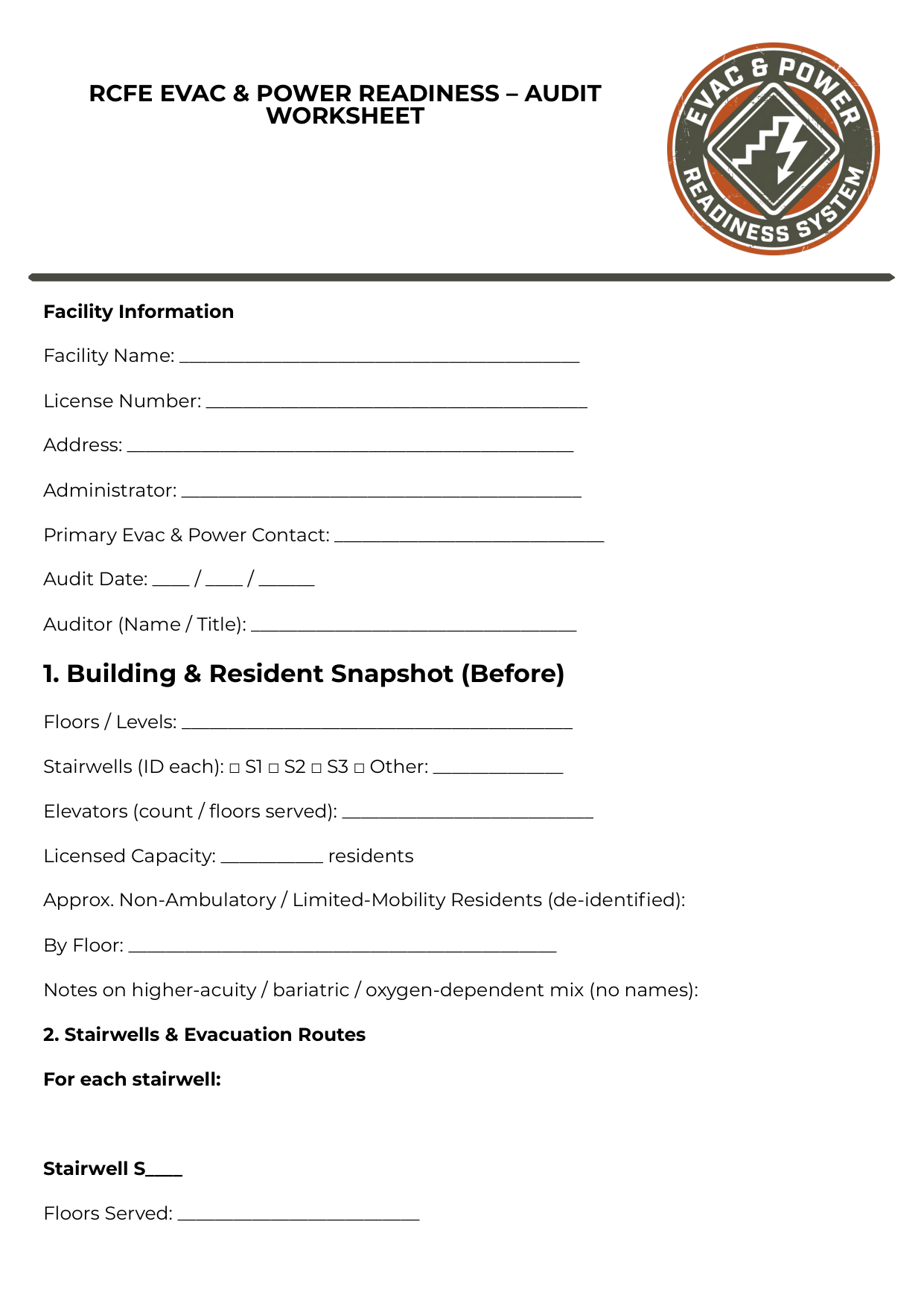
The RCFE Readiness Self-Assessment.
The same worksheet we walk in the audit — evacuation coverage, transfer method, power & 72-hour supply, training, and drill documentation. Score your facility by hand and see which areas are verified, unclear, or need attention.
SB 435 stalled. Outages didn't.
SB 435 would have required RCFEs licensed for 16+ residents to keep 72 hours of backup power. It passed the Senate 39–0, then was held in the Assembly Appropriations Committee in August 2026 — it is not law. What is law: HSC §1569.695 already requires every RCFE's emergency plan to keep the facility self-reliant for at least 72 hours after a disaster, including a power failure.
What SB 435 would have required →Title 22 · HSC §1569.695 · backup power, answered.
What does California Title 22 require for RCFE evacuation?
Title 22 requires a Residential Care Facility for the Elderly to be able to evacuate every resident — including non-ambulatory residents — and to document staff training and drills. When elevators are unavailable, that means a safe way to move residents down stairwells. Outpost's Evac & Power Readiness System supplies the equipment, training, and inspector-ready documentation to meet it.
Is California SB 435 law?
No. SB 435 would have required residential care facilities for the elderly licensed for 16 or more residents to maintain at least 72 hours of alternative power during an outage. It passed the Senate in June 2025 but was held in the Assembly Appropriations Committee on August 13, 2026, and did not pass in the 2025–26 session. Power planning is still required: HSC §1569.695 requires every RCFE's emergency and disaster plan to keep the facility self-reliant for at least 72 hours after an emergency, including a short- or long-term power failure. The E&PRS includes NUE SunCase battery power sized to the facility's critical loads.
Does an RCFE need evacuation chairs?
If a facility has stairs and residents who cannot self-evacuate, it needs a way to move them down the stairwell when elevators are out. HALO evacuation chairs let a single caregiver bring a non-ambulatory resident down the stairs in a controlled descent in under a minute — a documented, repeatable method staff can train on and drill.
What is the 72-hour self-reliance requirement (HSC §1569.695)?
California Health & Safety Code §1569.695 requires every RCFE's emergency and disaster plan to provide for the facility to be self-reliant for at least 72 hours immediately following an emergency or disaster, including a short- or long-term power failure. The same section requires staff training on the plan at hire and annually, and a drill at least quarterly for each shift. Outpost's Essentials+ Go-Bags and 72-hour supply kits cover the food, water, and supply side of that plan and are refreshed on the Compliance Guard cycle.
How do you evacuate a non-ambulatory resident from an upper floor?
A HALO evacuation chair rolls the resident to the stairwell; its track glides them down each step in a controlled descent that one caregiver can perform — no lifting, no backboard, no four-person carry. For bed-to-chair and floor transfers, ProMove slings move residents safely without staff injury.
What is the Evac & Power Readiness System (E&PRS)?
The E&PRS is Outpost Preparedness' turnkey readiness system for California RCFEs, delivered under one vendor: HALO evacuation chairs, ProMove transfer slings, NUE backup power, 72-hour supplies, on-site staff training, drills, and inspector-ready documentation (LIC 610E/999). It is built around Title 22 and HSC §1569.695 (as amended by AB 3098).
Your quote comes with a free on-site audit.
Every facility that runs the Readiness Score gets a personal review — no bots, no self-booking. Drew looks at your numbers and reaches out to schedule the audit around your operation.
- You get your score + quote — instantly, hardware or full system.
- Drew reviews your facility — personally, same day.
- We reach out to schedule your free audit — on your calendar.
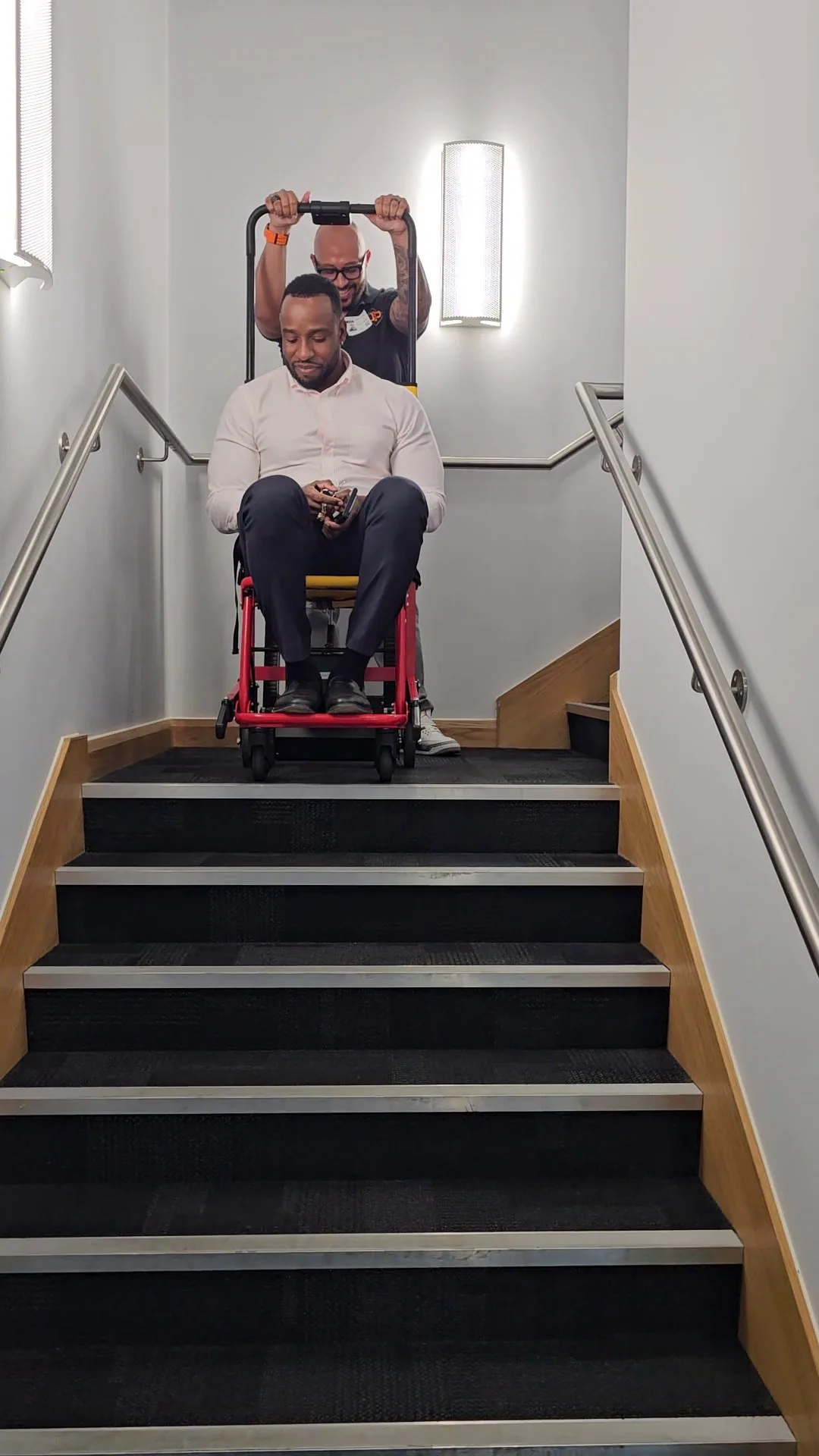
A resident who cannot walk out, and the chair that takes them.
The same equipment specified across the E&PRS: a HALO chair, one operator, a controlled descent.
We wrote these up in full.
Source-cited, no pitch, free to read. If you want to know whether this is a real problem before you talk to anybody, start here.
We pulled the state's public licensing export for all 13,230 licensed RCFEs and ranked every citation by regulation. Health and Safety Code §1569.695 — the emergency and disaster plan section — drew 472 citations in twelve months. The full table is free, with the method and the rows we excluded.
Health and Safety Code §1569.695 has required every residential care facility for the elderly to keep an evacuation chair at each stairwell since July 1, 2019. It is a flat requirement, not a plan, and it is separate from the emergency-plan language in the same section.
Correction, September 11, 2026: an earlier version of this article said SB 435 was law. It is not — the bill was held in the Assembly Appropriations Committee on August 13, 2026. Here's what it would have done, and what California already requires of every RCFE.